The Teranet January 2011 data have been released.
If you want to see the composite, which is running flat, you have to look in the lower right under the heading "Historical Charts - National Composite" and click on "Index Values and Sales Pair Count".
Vancouver rising.
Calgary down 1% month on month, which is an acceleration from the last two months. Another observation about Calgary is how sharp the discontinuity is in 2006. Might have something to do with the Spot Price of Brent Crude.
Toronto rising, just slightly. 1/2% gain month on month.
Ottawa on a steady decline that began in November 2010 and still rolls on at 1/2% per month.
Montreal rising slightly. Note that Montreal is the second most overpriced city in Canada. Unlike the others it shows much less of a dip during the 2008-2009 downturn.
Halifax up slightly, but the data are very noisy. I'm going to call it overall flat.
Wednesday, March 30, 2011


Some Tidbits from the Downturn Downunder
First time homebuyers are getting scarce. Fundamentals outweigh even master spruiking.
Values dip as first home buyers lost
Money Morning Australia passes on comments (? if it's a report, I haven't found it) from an RE industry guy in a state of capitulation.
Real Estate Industry Forecasts Major Price Falls
Values dip as first home buyers lost
Around $220 billion is loaned to residential buyers across Australia each year, of which 15 per cent has been taken up by the first home buyer segment over the past decade, equating to about $30 billion per year.
But during the recent boost (2009), this rose to 24 per cent with the annual borrow close to $53 billion.
During 2009, there were 190,850 first home buyers across Australia but in 2010, this figure dropped dramatically to 96,200. Hence, we are now experiencing a market impacted by the absence of first home buyers.
Money Morning Australia passes on comments (? if it's a report, I haven't found it) from an RE industry guy in a state of capitulation.
Real Estate Industry Forecasts Major Price Falls
“We anticipate a reduction in the median price from $601,500 in December last year to somewhere between 3-5% below that in March.” – Enzo Raimondo, CEO, Real Estate Institute of Victoria.
It seems it’s not just the so-called lunatic fringe saying the housing bubble has burst.
. . .
Make no mistake, a 3-5% drop in the median house price is big. Especially if you’re mortgaged to the eyeballs. For some, when you take into account the fees associated with buying and selling, it can mean the difference between walking away break-even or walking away with a big loss.
And I mean big.
A 5% drop from $601,500 is a fall of $30,075.
Chinese Enforcement of House Price Limits, Round 1
China penalizes property developer for pushing up housing prices
"The next stage of our housing project will be available in the first half of 2011 at the earliest, and prices are very likely to exceed 8,000 yuan a square meter," the company said in a notice to potential home buyers last December.
Ganzhou's price bureau imposed a fine of 500,000 yuan on the company and ordered the repayment of all money collected from potential buyers, in accordance with the country's Price Law.
Tuesday, March 29, 2011
#8 in Signs That the End is Nigh
I'll figure out what 1-7 are later. This just feels like number eight.
The U.S. bust was marked by blame. Not blaming Greenspan for the cheap money. Not blaming cuts to regulation that let the banks and wall street print money (in essence) and flood the housing (and auto and boat and rv) markets with liquidity and wholly unregulated securitization that created a pull system that encouraged every player in the game to push loans onto anyone and everyone despite their inability to actually afford the payments. NO, the blame went to the bloggers who were pointing out that the market was overdue to turn. These bastions of personal opinion read by dozens (maybe even more!) of people were, of course, responsible for swaying the entire market. Their pithy words of warning caused real investors to ignore the fundamentals of a "sound market" and caused legions of house-hungry newlyweds to instead live with mom and dad.
Of course they had such far reaching impact from their little blogs. Especially when, as the bloggers were forced to point out, they had been making those warning for years to absolutely no effect. All of a sudden, it was all their fault.
Admittedly, blogs are far more mainstream than they were in the heady days of 2006, but I call corner on sign #8 for Australia.
Property market slump? Blame me
Newsflash: if market fundamentals are sound, no one (especially not investors looking for properties with positive cash flow) will pay one lick of attention. It's a threat now because . . . ?
The U.S. bust was marked by blame. Not blaming Greenspan for the cheap money. Not blaming cuts to regulation that let the banks and wall street print money (in essence) and flood the housing (and auto and boat and rv) markets with liquidity and wholly unregulated securitization that created a pull system that encouraged every player in the game to push loans onto anyone and everyone despite their inability to actually afford the payments. NO, the blame went to the bloggers who were pointing out that the market was overdue to turn. These bastions of personal opinion read by dozens (maybe even more!) of people were, of course, responsible for swaying the entire market. Their pithy words of warning caused real investors to ignore the fundamentals of a "sound market" and caused legions of house-hungry newlyweds to instead live with mom and dad.
Of course they had such far reaching impact from their little blogs. Especially when, as the bloggers were forced to point out, they had been making those warning for years to absolutely no effect. All of a sudden, it was all their fault.
Admittedly, blogs are far more mainstream than they were in the heady days of 2006, but I call corner on sign #8 for Australia.
Property market slump? Blame me
So, the phone rings…
Agent: I just wanted to find out if you’re going to be as negative this week as you have in the last four weeks about the market because you are single-handedly making my life very f**king hard by reporting doom and gloom.
Me: I get the numbers like everyone else and the numbers compared to other years aren’t particularly good.
Agent: I’ve got to say you’re in a very powerful position there and the readers believe everything they read. If it’s in print they believe it. Just try and be a bit more balanced in your views.
Me: If you can give me an instance when I haven’t been balanced…
Newsflash: if market fundamentals are sound, no one (especially not investors looking for properties with positive cash flow) will pay one lick of attention. It's a threat now because . . . ?
Mortgage Insurance Risks to the Canadian Taxpayer
CMHC is backed by the full credit of the Canadian taxpayer, but they are only 70% of the market.
What of the remaining 30% of the mortgage insurance market?
Rating Mortgage Insurance Companies in Canada
The tax payers are backing the vast bulk of all insured mortgages. One has to hope that the insurance companies are aggressive at put-backs. Moral hazard would suggest the banks are not being very careful with the mortgages they are issuing. Unfortunately, the precedent from the 2008 downturn is to turn CMHC into a bailout mechanism, rather than an instrument of fairness.
And it's not just high loan to value mortgages that are backed, it's also any mortgage that is destined for securitization.
From Inside CMHC from Canadian Mortgage Trends.com
I love in this interview how they say, oh well, all is good since we hold 2x the capital required by OSFI, but never actually say what that number is.
The Minimum Capital Test is here. Pages 35-41
Mortgage insurance margins range from $.10 to $1.10 on $100 of original mortgage amount with factors applied to these of .04 to 1.75. This supports the generally cited number of 1.5% or so. Minimum capital requirements vary by the portfolio the company is holding at any time.
Note: profits from CMHC all these years have been dividended back to the Canadian Government, i.e. the tax payers (except for 2008 when they held it back and built reserves instead). It's not like the potential capital they could have been holding vanished; it's been spent on other things. It's possible that if the mortgage insurance fee has been set properly, even if the capital requirements look thin, the tax payers will not end up in the red, overall, but they are acting as secondary insurers, whether they want to be or not. And in reality, mortgage insurance is just a tax since much of it goes on a pass thru to the government.
What of the remaining 30% of the mortgage insurance market?
Rating Mortgage Insurance Companies in Canada
• The insurance company covers 100% of the loan plus accrued interest against loss by the lender if the
borrower defaults.
• To establish a degree of parity between the CMHC and private MI providers, the government of Canada
provides a 90% guarantee of private MI claims. This places the private and public sector mortgage insurers
on a more level playing field for the purposes of calculating a lender’s risk exposure to MI providers.
The tax payers are backing the vast bulk of all insured mortgages. One has to hope that the insurance companies are aggressive at put-backs. Moral hazard would suggest the banks are not being very careful with the mortgages they are issuing. Unfortunately, the precedent from the 2008 downturn is to turn CMHC into a bailout mechanism, rather than an instrument of fairness.
And it's not just high loan to value mortgages that are backed, it's also any mortgage that is destined for securitization.
From Inside CMHC from Canadian Mortgage Trends.com
Pierre: At the end of 2008, the percentage of insured mortgages outstanding, compared to residential mortgage credit outstanding, was estimated at 68%.Unfortunately, I couldn't find any newer numbers than this.
Noteworthy: A large percentage of insured mortgages are under 80% loan-to-value. That’s because many lenders use CMHC “portfolio insurance” (which provides the same default insurance coverage as for high ratio mortgages) to lower capital requirements and/or as a prerequisite to securitizing their mortgages
I love in this interview how they say, oh well, all is good since we hold 2x the capital required by OSFI, but never actually say what that number is.
The Minimum Capital Test is here. Pages 35-41
Mortgage insurance margins range from $.10 to $1.10 on $100 of original mortgage amount with factors applied to these of .04 to 1.75. This supports the generally cited number of 1.5% or so. Minimum capital requirements vary by the portfolio the company is holding at any time.
Note: profits from CMHC all these years have been dividended back to the Canadian Government, i.e. the tax payers (except for 2008 when they held it back and built reserves instead). It's not like the potential capital they could have been holding vanished; it's been spent on other things. It's possible that if the mortgage insurance fee has been set properly, even if the capital requirements look thin, the tax payers will not end up in the red, overall, but they are acting as secondary insurers, whether they want to be or not. And in reality, mortgage insurance is just a tax since much of it goes on a pass thru to the government.
China Bubble Continues to Spread
Third tier cities now involved.
Evergrande's Net Soars on Tertiary Cities
Just in case you think these companies found some way to make money building affordable housing . . .
Evergrande's Net Soars on Tertiary Cities
"Given that third-tier cities are generally less affected by the macro adjustment and control policies, the room for urban development is broad and the demand and growth potential for housing are immense," said Chairman Hui Ka-yan.
As of Dec. 31, the group had total land reserves of about 96 million square meters distributed among 62 cities in China, including 21 second-tier cities and 39 third-tier cities.
Just in case you think these companies found some way to make money building affordable housing . . .
Evergrande said it will continue to pursue a development model focused on quickly bringing mid- and high-end housing to market, adding the company put more than 70% of its new development projects up for sale within six months of acquiring the land last year.
Friday, March 25, 2011
China Affordable Housing Expected Shortfall on Money and Profit
The lack of affordable housing doesn't affect the bubble, except as a foil to claim there is demand, but it does affect social stability, which could burst the bubble.
China’s Housing Plan to Face Financing Challenge, Cushman Says
China’s Housing Plan to Face Financing Challenge, Cushman Says
China’s biggest challenge in its plan to build 36 million affordable homes over five years is the ability to tap funding and draw developers to work on the projects, Cushman & Wakefield Inc. said.
The nation needs 1.3 trillion yuan ($198 billion) for its affordable homes this year, excluding land costs, Housing and Urban-Rural Development Vice Minister Qi Ji said on March 9. The central and local governments will only provide 500 billion yuan, Qi said.
Thursday, March 24, 2011
CHMC, Fannie Freddie, Baby Meet Bathwater
The CMHC: Canada’s mortgage monster
What is also roundly ignored is the role the Fannie and Freddie (and FHA) played after the crash, when every credit market was frozen, in providing a lender of last resort. People thought house prices fell rapidly as it was? Imagine no mortgages for months on end, at all. That is their true charter. We can get rid of Fannie and Freddie (and continue to ignore the real causes of the boom and bust), but without systemic repairs to the system that no one has the political will to make we are going to repeat this housing bubble, and be forced to recreate a Fannie/Freddie style entity to stave off another Great Depression when the markets again seize up. Be nice to actually address the real problems.
These types of entities can safely exist (Fannie and Freddie existed since 1938 and things went along fine until the deregulation of 1999/2000 that banned all oversight of derivatives), but their charter and their compensation need to be set down properly. Fannie and Freddie (and the 24/25 of the top mortgage lenders that didn't have to meet CRA, yet loaned out money to unqualified people) were allowed to operate in this reckless manner because the right people were getting rich off of it. Follow the money before following the politics. It's more likely to lead you to the root cause of the problem, and shed light on the solution, i.e., make management pay, personally, for losing other people's money.
CMHC is no different. The politics of housing for all is a convenient smokescreen. Who's making the money?
“Did the banks all of a sudden open up the lending spigots? In fact banks have actually reduced the number of their mortgages held from the peak of third quarter of 2008. The smoking gun is the CMHC and its securitization policies.”Moral Hazard, it isn't just for Wall Street.
Almost immediately, LePoidevin’s bosses at National Bank leapt to the CMHC’s defence.Ah, Cassandra, poor Cassandra.
Even worse, the public knows next to nothing about what lurks inside the CMHC’s books, aside from the smattering of details it releases in its annual report. And, unlike every other major insurance provider in the country, the CMHC doesn’t answer to Canada’s top financial services regulator.Really? That's weird and/or convenient. In the U.S. they had to answer, but the oversight agencies had been defunded to the point of uselessness. A process that is repeating itself forthwith given the Republican takeover of congress. Absent direct oversight the only hope is the incentive structure has been set up rationally.
Yet on specific decisions that dramatically loosened mortgage lending rules last decade, CMHC officials have testified they did so on their own with the approval and oversight of the CMHC’s board of directors—a board that includes a political consultant, real estate developers, a small-town lawyer and even the owner of a plumbing company—though not one single economist or recognizable financial services professional.Oh. Snap.
“The CMHC is influenced by the political process, just like [Fannie Mae and Freddie Mac] were in the United States,”They were influenced by profit more, specifically bonuses to management. If you want an entity like this to act in the best interests of others, the compensation needs to be designed to mimic the larger risks and rewards. Moral Hazard was operating at many levels. And if you interview these guys from Countrywide, BoA, etc, they still claim they don't know what happened. They never watched the numbers that mattered because from their perspective of making money for their pocket, they truly didn't matter.
What is also roundly ignored is the role the Fannie and Freddie (and FHA) played after the crash, when every credit market was frozen, in providing a lender of last resort. People thought house prices fell rapidly as it was? Imagine no mortgages for months on end, at all. That is their true charter. We can get rid of Fannie and Freddie (and continue to ignore the real causes of the boom and bust), but without systemic repairs to the system that no one has the political will to make we are going to repeat this housing bubble, and be forced to recreate a Fannie/Freddie style entity to stave off another Great Depression when the markets again seize up. Be nice to actually address the real problems.
These types of entities can safely exist (Fannie and Freddie existed since 1938 and things went along fine until the deregulation of 1999/2000 that banned all oversight of derivatives), but their charter and their compensation need to be set down properly. Fannie and Freddie (and the 24/25 of the top mortgage lenders that didn't have to meet CRA, yet loaned out money to unqualified people) were allowed to operate in this reckless manner because the right people were getting rich off of it. Follow the money before following the politics. It's more likely to lead you to the root cause of the problem, and shed light on the solution, i.e., make management pay, personally, for losing other people's money.
CMHC is no different. The politics of housing for all is a convenient smokescreen. Who's making the money?
It points out that the Canadian mortgage system is fundamentally different than in the U.S. . . . lenders can generally go after homeowners who don’t make their payments.I love this one. In a collapse there is no money to go after. This is no different than asserting that household balance sheets look healthy because you are including an inflated house value on the asset side.
says Serré, adding that rising home prices have also helped improve the debt picture.Oh, there it is. What do I win?
Serré declined to comment directly on Macdonell’s remarks. “I’m not exactly sure what low or poor credit is,” he says. “But I want to make clear that our mandate is not to get people into home ownership, our mandate is to provide the housing of choice. The last thing we want, as a government insurer, is to get people in a position where they can’t manage their debt.”What is "housing of choice"?
From the About Us page: Today, CMHC remains committed to helping Canadians access a wide choice of safe, quality, affordable homes, and making vibrant and sustainable communities and cities a reality across the countryRecent experience strongly suggests that, absent a equivalent-rent-adjusted limit on mortgage amounts, making mortgages more affordable simply makes housing unaffordable. Maybe you need to look at that charter again.
China Housing Price Controls Set Higher Than Analysts Expected
China’s Property Stocks Rally on Price Target Speculation (1)
Leaving aside the notion of enforcement of this law, if I'm reading this right, the rise year on year since December in places like Shanghai would be perfectly acceptable.
I do so want to see how they are going to try to implement this.
“There’s market speculation that local governments will set a target of limiting housing price gains to between zero percent and the GDP growth rate,” said Wang Weijun, a strategist at Zheshang Securities Co. in Shanghai. “That’s much better than the target of below zero percent anticipated by the market.” Local governments may announce their price control targets next week, Wang said.
Leaving aside the notion of enforcement of this law, if I'm reading this right, the rise year on year since December in places like Shanghai would be perfectly acceptable.
I do so want to see how they are going to try to implement this.
Tuesday, March 22, 2011
Earthquakes and Vancouver Housing Sentiment
Real estate, especially where prices have already exceeded the economic value of the underlying property (compared to rents), is susceptible to shifts in sentiment. Will the recent earthquakes on the other parts of the ring of fire cause buyers, specifically foreign buyers, to shy away? Vancouver is attractive as a haven, for money, from political uncertainty. One might expect that its lacking in being a long-term haven from natural disaster would damage that overall reputation. Not that anything in Vancouver or BC has changed, just that buyers' risk assessment will have.

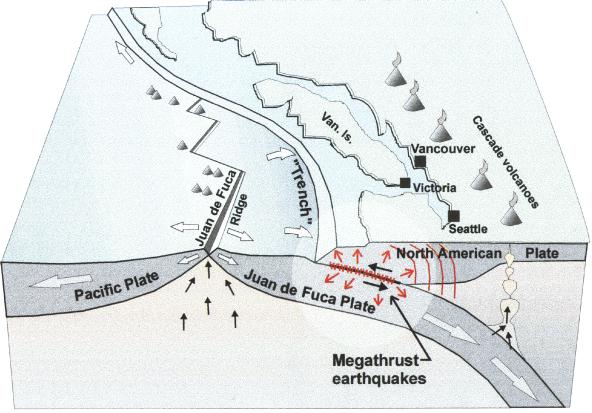
I wondered how the real estate friendly press was handling this.
The Sun took the survey route, pointing out that residents don't believe their municipalities are prepared. This doesn't mean they aren't, just that people don't have faith.
The Times Colonist in Victoria takes a pablum approach. I especially like the close: She suggests the public visit the Provincial Emergency Program website at pep.bc.ca, or go to the "public health" section of www.viha.ca should an event occur. If it's a significant event, I'm not sure that's going to work.
Vancouver Island suffered a ~9.0 earthquake in 1700. The evidence suggests that it took place at about 9 p.m. on January 26, 1700 (NS). Although there were no written records in the region at the time, the earthquake's precise time is nevertheless known from Japanese records of a tsunami that has not been tied to any other Pacific Rim earthquake. Long live irony.
The City of Richmond assures residents that buildings are safe, even considering the risk of liquefaction of the soil. Relax, your lives are safe. Your 1.5 million dollar house will be cracked and bit sunken in.

The Sun took the survey route, pointing out that residents don't believe their municipalities are prepared. This doesn't mean they aren't, just that people don't have faith.
The Times Colonist in Victoria takes a pablum approach. I especially like the close: She suggests the public visit the Provincial Emergency Program website at pep.bc.ca, or go to the "public health" section of www.viha.ca should an event occur. If it's a significant event, I'm not sure that's going to work.
Vancouver Island suffered a ~9.0 earthquake in 1700. The evidence suggests that it took place at about 9 p.m. on January 26, 1700 (NS). Although there were no written records in the region at the time, the earthquake's precise time is nevertheless known from Japanese records of a tsunami that has not been tied to any other Pacific Rim earthquake. Long live irony.
The City of Richmond assures residents that buildings are safe, even considering the risk of liquefaction of the soil. Relax, your lives are safe. Your 1.5 million dollar house will be cracked and bit sunken in.
Subscribe to:
Posts (Atom)