Wednesday, April 11, 2012

Chinese Lending Scam Business is Liquidated

Liren Group owed 700-800 million dollars to 7000 creditors. The crash came when they failed to obtain bank loans to pay back the creditors. A bit of the reversal on the usual playbook where businesses obtain bank loans at low rates and turn around and lend it out in the shadow banking system.

More than half of nearly 3000 businesses surveyed in Zhejiang had sought loans from the shadow banking system.

Liquidation begins for firm embroiled in lending scam
Authorities also warned local officials who are Liren's creditors not to abuse their power to grab the liquidated assets in advance or to put themselves as prioritized creditors to be repaid first.
 Liren's downfall has raised concerns about private financing risks, an issue that has become particularly relevant in Zhejiang, where private businesses have become a pillar of the prosperous local economy.

Friday, April 6, 2012

Canadian Financial Regulator Says Banks Don't Always Follow Board Policies

Color me shocked. How do you rack up the same debt as Americans and run house prices to nearly double that of the U.S. without some fudging around the edges?

Banks execs get measured on performance today. Every percentage of market share stolen by a competitor who is fudging more that month is a hit on performance. Banks engage in a race to the bottom or they lose business.

Financials regulator says bank executives don't always follow board policies
ORONTO - Bank executives in some cases have not been following policies set down by their boards of directors, raising the possibility of undue lending risks, Canada's banking watchdog said Thursday. Julie Dickson, head of the Office of the Superintendent of Financial Institutions, said the federal agency has created a new safeguard against such practices as part of a slate of proposed new guidelines. "Going forward senior management will have to provide a declaration to the board that the financial institution is in compliance with the OFSI guideline (that they are following board policy)," she said.
According to the article 42% of bank assets in Canada are real estate.

Profits and Balance Sheet Developments at U.S. Commercial Banks in 2005
These financial and economic conditions left an imprint on banks' balance sheets. The relatively low level of fixed mortgage interest rates and the rapid climb in the prices of residential and commercial real estate spurred the demand for bank loans secured by real estate, and the share of bank assets attributable to real estate loans rose to nearly one-third.
The U.S. banks were pushing nearly 33% right before the crash and Canada is at 42%? Seriously folks. Did you miss that blood bath suffered just south of you?

Checking in with Australia...

From Steve Keen
http://www.debtdeflation.com/blogs/2011/04/11/this-time-had-better-be-different-house-prices-and-the-banks-part-2/
You can also see in this chart how badly the bubble sucks down other development funds that might actually be directed into something economically productive.

Majority of Canadians Don't Intend to Buy a House

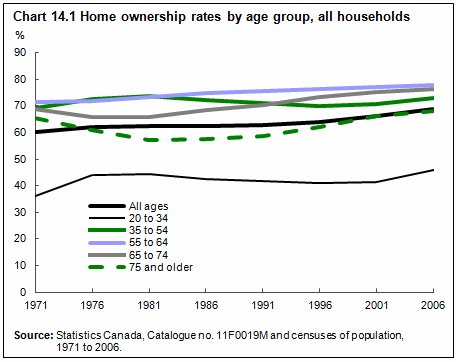
73% report they are unlikely to buy in the next two years. Given that ultra low interest rates have already pulled far more households into ownership than in the past (see chart, and probably safe to assume that overall trend continued upward for 6 more years), it's unclear who the remaining potential buyers actually are. New grads? Second home buyers?

This bubble has to scrape the margin another round to sustain itself. This survey implies the remaining margin comprises wishful thinkers and speculators.

Home ownership rates Canada 
http://www.statcan.gc.ca/pub/11-402-x/2011000/chap/fam/fam-eng.htm
Most Canadians plan no home buying in next 2 yrs-RBC
However, 46 percent of those polled expected mortgage rates
to stay at ultra-low levels next year, up sharply from 30
percent in 2011. The poll also found that nearly 60 percent felt
this year was a good time to buy a house, compared to 41 percent
that felt 2013 would be better. 
60%? Speaking of wishful thinkers...

Bubble in New Zealand Hits New Highs

Property sales in Feb up 37% Year on Year
Listings up 8% Year on Year.
Property asking prices in New Zealand reach record levels
The seasonally adjusted truncated mean asking price for listings in March rose again to a new record level of $429,865 up $3,300 from February. This pushes the asking price up to another new high. The trend in the last three years very clearly shows an accelerating growth in asking price over the recent 12 months as compared to 2010/2011. ‘Eagerness to buy matched to availability of attractive financial support is however not being met with a consistent and sufficient supply of new listings. This scenario continues to drive this sellers’ market, where it is clear those homeowners who are putting their property on the market are expecting to see a higher sale price as flagged by the new record level of asking price in March,’ says the report published by Realestate.co.nz.

Tuesday, April 3, 2012

Chinese Heavily Shopping for U.S. Property

When the credit taps in China, Canada and Australia get cut off, I expect the U.S. market to start another downward leg. It's still overpriced by 7%. Chinese Buy Expensive U.S. Homes
In the U.S., the Chinese are now the second-largest foreign buyers of homes, behind Canadians, accounting for $7.4 billion of sales in the 12 months ended March 2011, up 24% from the previous 12 months, according to the National Association of Realtors. Buyers from China and Hong Kong also spent $1.71 billion on commercial property in the U.S. in 2011, more than quadruple their investment in 2008, says Real Capital Analytics.

Those numbers likely understate Chinese investment, as investors may buy property under business entities they've set up in the U.S., says Patrick O'Neill, founder of ONeill Group, a Hong Kong-based company that helps Chinese buyers find U.S. property.
One of her recent mainland Chinese buyers paid $5 million for a 5,000-square-foot home in Pasadena that the family expects to occupy for one month a year, she says. "They treat it like a hotel without room service," says Chang, who estimates that a quarter of shoppers in the $3 million-plus market in her area are from mainland China.

Mainland Chinese also account for a third of the buyers at luxury home builder Toll Bros.' new home development, The Heritage in Vista Del Verde in Yorba Linda, Calif., southeast of downtown Los Angeles. In the San Francisco Bay Area, Realtor Stanley Lo of Green Banker real estate says mainland Chinese — a third of his clientele — are looking for homes priced at $800,000 and up. Most of his clients are Chinese business executives, who can afford second homes. They follow friends, relatives or work colleagues to the suburbs between San Francisco and the Silicon Valley.

. . .

In New York City, mainland Chinese are increasingly paying cash for $20 million "trophy apartments," says Pamela Liebman, CEO of The Corcoran Group, a residential real estate brokerage company. Based on current trends — and the increasing numbers of mainland Chinese buyers — Liebman expects they'll account for one in 10 uber-luxury buyers in the next year or two.

High Inventories in Vancouver

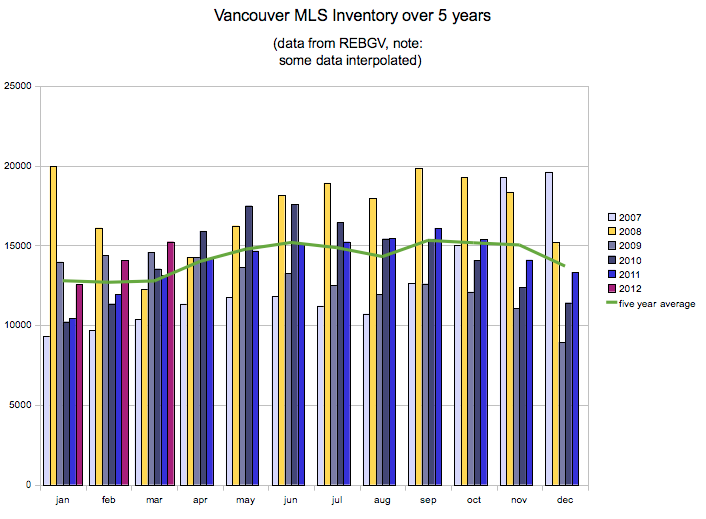
Vancouver is at high inventories for March. New listings just yesterday were 450. Falling sales, increasing inventory.

REBGV March 2012 Statistical Report
The Real Estate Board of Greater Vancouver (REBGV) reports that residential property sales in Greater Vancouver reached 2,874 on the Multiple Listing Service® (MLS®) in March 2012. This represents a 12.9 per cent increase compared to the 2,545 sales recorded in February 2012, a decline of 29.6 per cent compared to the 4,080 sales in March 2011 and an 8.4 per cent decline compared to the 3,137 home sales in March 2010.

March sales in Greater Vancouver were the second lowest total for the month in the region since 2002 and were 16.8 per cent below the 10-year sales average for the month.
Full package can be found at the blog of Realtor Mike Stewart.
Greater Vancouver MLS Inventory (Note some data late 2007 early 2008 interpolated because REBGV stopped reporting total inventory during this time.)
Vancouver Home Sales
Vancouver Home Prices

New Zealand Nibbles Away at Edge of Consumer Debt Bubble

New loan shark laws unveiled
Among the proposed changes, the bill would make it illegal to lend someone money whose loan repayments would be likely to result in substantial hardship.

The legislation would also require complete disclosure of loan terms and extending the period during which borrowers can cancel their loan.

"These will be the biggest changes to consumer credit law in a decade. It is time for a significant shift in lending laws to increase protection for borrowers and target irresponsible lenders," Tremain said.
Given the massive increase in household debt there are a lot of potential prey for lenders.
Household debt New Zealand
http://www.rbnz.govt.nz/keygraphs/fig5.html

Oversight Increases on CMHC

Looks like Harper and Flaherty are going to step back and let OSFI handle letting the air out of the bubble. Politically safe move. Ottawa to toughen CMHC oversight
“The issue that pushes them near their lending limit is the desire of some of the financial institutions to purchase portfolio insurance for their low ratio mortgages,” Mr. Flaherty said.

“That’s not the way most people usually think of CMHC.”

Just three years ago, CMHC had $450-billion in loans it was backstopping and had to go to the government to get that increased to $600-billion.

“A legislative framework will support financial stability”

CMHC currently falls under the jurisdiction of the minister responsible for Human Resources and Skills Development Canada. But sources have indicated the Crown corporation could soon fall under direct supervision of the Office of the Superintendent of Financial Institutions — a powerful financial regulator with the power to enforce a broad range of changes at a financial institution.
It's unfortunate that CMHC was not used to manage access to housing credit when interest rates fell (which would have had a net effect of funneling more money to business and encouraging consumers to pay down debt), instead of the opposite (adding more fuel to the household credit fire).

Monday, April 2, 2012

RBC in Trouble Again with U.S. Regulators

This looks like it violates the letter of the law being applied, less so the spirit. Also, it seems like RBC doesn't seem to realize that the climate has, you know, perhaps shifted a bit on financial shenanigans between 2005 and present day. U.S. regulator accuses Royal Bank of ‘wash trade’ scheme
The Commodity Futures Trading Commission, which regulates derivatives trading in the U.S., said in court documents Monday that senior officials at RBC created “a wash trading scheme of massive proportion” that enabled it to earn Canadian tax credits.

The scheme is the largest that the CFTC has ever brought forward based on the value of the securities traded, which it said were in the “hundreds of millions of dollars.” But the bank issued a statement strongly denying the charges, saying it sought clearance from the CFTC as far back as 2005 to make the trades in question. A bank spokeswoman said the impact of the case was “not a financially material event.”
Just the latest trouble . . . Royal Bank of Canada's Reputation Takes Hit
In September, RBC Capital agreed to pay US$30.4 million to settle U.S. Securities and Exchange Commission civil charges of misleading five Wisconsin school districts that lost US$200 million invested in risky securities. The SEC said RBC didn't fully disclose the risks in 2006 when the school districts bought the investments. RBC neither admitted nor denied wrongdoing.

Last July, Massachusetts's top securities regulator sued RBC Capital Markets LLC and Michael Zukowski, a former RBC employee, for allegedly selling complex exchange-traded funds to clients that didn't understand them, causing 35 investors to lose almost US$800,000.

Toronto Buyer Files Complaint Over Realtors Driving Bidding Wars

Toronto real estate: First foray into bidding wars leaves homebuyer bruised
Gallant thinks RECO should be reviewing what have now become commonplace practises in the GTA: brokers “underlisting” properties for far less than their market value and then holding off accepting bids until there is a frenzy of demand that many believe has helped fuel the bidding war frenzy and driven up prices.

Bidding wars are no longer just a City of Toronto phenomenon, according to a recent ReMax study. They are impacting househunters in suburban areas, as well as some cities in resource-rich provinces such as Manitoba, Alberta and Nova Scotia.

“I’ve gotten to the point where if they are holding back offers, I won’t even bother to go see the house,” says Gallant, who’s been looking in earnest for a month now in the Vaughan and Newmarket areas with her fiancĂ©.
More buyers need to learn to walk away.