Wednesday, September 12, 2012

Australian House Prices to Fall 20% Over Two Years

A conservative assessment of Australian housing by the Wall Street Journal. Two years to decline 20% at this point in the market is about half the rate of decline of the U.S. That will still be painful.

Home Prices Tipped to Fall by up to 20%
Investec Asset Management strategist Michael Power said while Australian property prices had fallen six per cent since 2010, he expected them to fall further in the next 18 months to two years. "We're not seeing anything like the US, Irish or Spanish property bust here," the South African-based strategist told a business lunch in Sydney. "But I think over the next 18 months it could go down by double digits, 12 or even 15 (per cent). A 15 to 20 per cent (fall) would be my outside downside over the entire period."
He goes onto say that well, yes consumer debt is very high, the banks may be in trouble because of foreign debt financing, but there likely won't be any inflation.

I wish the article were longer because it would be interesting to hear how he thinks those conditions can possibly resolve without inflation. The chart below from oanda.com shows how buoyant the currency is. During the global liquidity freeze of the Great Recession the Australian dollar lost a lot, quickly, relative to the U.S. dollar. Australian foreign debt is ~1.2 trillion on ~1.6 trillion GDP.


Saturday, September 8, 2012

Heard This One?

Based on the official housing statistics, you might have guessed that the sellers would have made out just fine, despite all the talk of a real estate slump.
House prices nearly tripled in the first half of this decade, and speculators, who are more likely than residents to sell a house in a panic, flooded into the area in recent years.
The truth is that the official numbers on house prices — the last refuge of soothing information about the real estate market on the coasts — are deeply misleading. Depending on which set you look at, you’ll see that prices have either continued to rise, albeit modestly, or have fallen slightly over the last year. But the statistics have a number of flaws, perhaps the biggest being that they are based only on homes that have actually sold. The numbers overlook all those homes that have been languishing on the market for months, getting only offers that their owners have not been willing to accept.
Unfortunately, there are also a lot of families that took on huge mortgage debts based on the ephemeral peak values of their properties. In effect, they cashed in on the housing boom without cashing out. As Ed Smith Jr., the chief executive of Plaza Financial Group, a mortgage brokerage firm near San Diego, said, “So many people picked up their homes, turned them upside down and shook them like a piggy bank.”
The withdrawals have been so big that the average household in Boston now has slightly less equity in its home than it did in 2000, according to an analysis by Moody’s Economy.com that took inflation into account.
All of the above are from this article: What Statistics on Home Sales Aren’t Saying New York Times 2006

Flash forward to 2012:
In addition to the level of debt, the way it is employed may also affect out- comes during periods of economic stress. If debt has been used to finance household consumption, for example, consumption may be constrained following a shift toward reducing debt burdens. In “Household Borrowing and Spending in Canada,” Jeannine Bailliu, Katsiaryna Kartashova and Césaire Meh focus on how the accumulation of debt is related to household expenditures, specifically consumption and spending on home renovation. They observe that the share of consumption financed by home-equity extraction has risen since 2000. They also note that a much larger share of spending on home renovation is financed by these debt flows. Home-equity extraction in turn has been supported by rising house prices and financial innovation. Simulation results suggest that a negative shock to house prices could have a relatively large impact on consumption.

--Bank of Canada
Check out the associated chart:
House prices have doubled, but Canadian housing equity has been falling. (Looks about level with 2000 values or up very slightly, but this is in an environment of greatly increasing "values". It's nuts.) Of all the parallels with the U.S. worth panicking over, this should be high on the list.

That crossover point where the growth in mortgage debt begins to exceed the growth in real estate values . . . that's interesting marker. That's the point where the central bank lost control through relaxation of mortgage standards.

Back to the article, the trigger for the angst was an auction of foreclosed property.
The highest bid on one three-bedroom ranch house with a pool was $671,000. In 2005, the same house sold for $809,000. Another house, just steps from Naples Bay, received a high bid of $880,000, compared with $1.35 million a year earlier. On average, the bids suggested that the houses at the auction had lost about 25 percent of their value since 2005, according to Thomas Lawler, a real estate consultant who analyzed the results.
More coverage from that era:

Realtors fume over property auction
Some local real estate professionals are livid. It’s bad enough that sales of single-family houses in the Naples area has dipped nearly 50 percent.

Now, an impending auction of 45 prime properties has locked up the market, Realtors contend.

. . .

However, the proposed auction has tied up the real estate market for the next few weeks, some Realtors protested in early October.

People have stopped buying so they can wait and see what they can pick up at the Oct. 21 sale, at which they can bid online or at the Naples Beach Hotel & Country Club for some 45 homes primarily in The Moorings, Lake Park, the northern boundaries of Old Naples and Cape Coral.

. . .

Real estate professionals say it is especially obnoxious because many of the properties that will be sold on the auction block — by seller desire, not because they can’t pay the taxes — were purchased by speculators who likely attempted to manipulate the market.

“The majority of investors are selling off with little or no profits. Look at the 11 homes (in Lake Park) going up for auction by an investor now,” says longtime Naples resident and Remax Elite real estate agent Jerry Krecicki.
Noting that assessed value and sales price are a matter of public record, Turner cited a house at 1121 10th Ave. N. that listed for $569,000 on March 5, 2005. Moorings resident Marjorie S. Dresner bought the house on March 7, 2005, and closed on it on April 26, 2005.

For $585,000, Turner said.
The Buyer Today is Going to Wait for Prices to Soften
The Naples News reports from Florida. “The deadline for closing on properties purchased in an Oct. 21 auction has been moved back to Dec. 6. Auction operator Paul Drake said he wasn’t aware that one of the properties for which he’d announced a high-bid price is now in foreclosure.”

“In legal ads printed in the Daily News, Washington Mutual Bank announced foreclosure on 1121 10th Ave. N., although the ads refer to it as Lot 22, Resubdivision of Block A, Lake Forest. The owner of record, Marjorie Dresner, had numerous properties listed in Drake’s auction.”

“Shortly after the event, Drake said that property at 1121 10th Ave. N. drew a contract price of $341,000. Public records show that Dresner bought the house in May 2005 for $585,000, with an April 26, 2005, loan from Washington Mutual. Mortgage documents show Dresner took out a loan worth $468,000 plus interest.”

“That is part of the problem, real estate professionals protested, before and after Drake’s advertised auction. It was unrealistic, because many of the top bid prices were far less than the mortgage prices, they said.”

“While Drake had denied financial hardship was involved for people who had put their properties up for auction, real estate analysts noted that a few days before the auction, Dresner had taken out a second mortgage on most of her participating properties.”
“News of the auction ignited debate about Naples’ real estate market, and whether sales prices were dropping drastically.”
Well, let's go take a look, shall we?
Zillow Map
Back to the 2006 NYT article:
Over the last few decades, the world’s financial system has endured a crisis roughly once every three or four years. There was the stock market crash of 1987, the Asian and Mexican meltdowns in the 1990s, the dot-com implosion of 2000 and, most recently, the aftermath of Sept. 11, 2001. We may now be living on both borrowed money and borrowed time.

Friday, September 7, 2012

Toronto City Detached House Prices Down 14%

Median detached house prices within the city of Toronto have been plummeting. In April 2012 the median was $656,000. This month it is $577,250. That's a decline of $79,000 or nearly 14%.

Detached for all of the TREB region ticked up slightly this month, but is still down 6% or $35,000. Imagine if interest rates normalized.

Total sales down 12% from a year ago, matching Vancouver's falling sales trend. Average was up, if you want some soothing news to go with your charts.

I've added Toronto to the Canadian City Price Peaks and Declines


On the condo front, things continue to slide.

The potential losses for speculators in condos, per unit, is not all that high in comparison to, say, Vancouver Richmond or West Van. From Shiller's interview on BNN (hat tip: VREAA). Corrected for inflation, condo prices Boston, Toronto:

Since 2000 the prices have risen 60% (20% of it in the last calendar year). Not extreme, but given the anecdotal stories of investors buying 3, 4, or even 5 at a time, many investors may have similar exposure as a Vancouver speculator holding only one property. The scale of risk may actually be the same.

For those keeping a scorecard, a 60% overvaluation is corrected by a 37.5% decline.

The Effect of Rate Cuts on House Prices

The Central Bank went for the save on Australian house prices in May, then had to spike the punch again a month later. I borrowed the chart from this Joye piece. Australian house prices stabilise in August
Rate cut dates marked by me
Rates were left alone last week, but a cut is expected by the end of the year. More on that here if you are interested.

Australian Construction Contracting Faster

Australian Construction Contracts Fastest Pace in 11 Mths
The construction performance index fell to 32.2 last month from 32.6 in July, a survey by the Australian Industry Group and the Housing Industry Association released in Sydney today showed. A reading below 50 represents a contraction.
“The near-term outlook for the construction sector deteriorated with a further fall in new orders,” said Peter Burn, the Australian Industry Group’s director of public policy, said in a statement. “The drop-off in new orders was particularly sharp for engineering construction and the apartment sub-sector.”
Thus begins the vicious cycle.
BHP Billiton Ltd., the world’s biggest miner, last month decided to delay approval of an estimated $33 billion expansion of the Olympic Dam copper, uranium and gold mine in South Australia. Fortescue Metals Group Ltd. (FMG), Australia’s biggest iron ore producer after Rio Tinto Group and BHP, this week cut its full-year capital spending forecast by 26 percent to $4.6 billion.
China's manufacturing sector entered contraction too.

Tuesday, September 4, 2012

Seeking Alpha: Short RBC

2 Canadian Banks To Buy, 1 To Short On Housing Bubble Burst
There is sufficient data to suggest that the red hot Canadian housing markets are now cooling down. In the wake of recent developments in the Canadian housing markets, we have buy ratings for Toronto-Dominion Bank (TD) and the Bank of Montreal (BMO). These buy ratings are justified on the basis of the banks' higher proportion of insured mortgages, lower proportion of mortgage lending to their overall lending portfolio, and attractive valuations. Since the Royal Bank of Canada (RY) has no insured mortgages, we believe it is poised to take the maximum hit if the Canadian housing market bubble bursts, which is why we are bearish on the bank.
There is a rundown of each major bank.
Royal Bank of Canada (RY)

The bank, with a Tier 1 capital ratio of 13% and a Tier 1 common ratio of 10.3%, is adequately capitalized when compared to BNS. RY relies approximately 70% on Canada for its revenues, while the rest accrue from other international markets where it has its operations. Fitch considers the bank to have considerable exposure to the Canadian housing markets and faces the largest risk, as it uses less mortgage insurance as compared to most of its peers in the Canadian Banking Industry. In their conference call, after reporting the results of the third quarter of the current year, the management noted that the bank has the lowest insured mortgages of all the banks in Canada. The bank also has a large portion of its domestic mortgage loans to its overall lending. Going forward, we believe the bank will face a challenging operating environment, however, the bank's concentration on its credit card and commercial businesses will partially offset any adverse impacts.

Monday, September 3, 2012

The Australian House "Auction"

House auctions are far more popular in Australia and New Zealand, where around 40% of sales are conducted this way. But the idea of an auction can get pretty whack.

Vendor bid auction reform needed
A high-profile Melbourne buyers' agent has called for the introduction of a limit on the number of vendor bids allowed to be placed at Victorian property auctions. There is no cap on the number of vendor bids at Victorian auctions.
Okay, let's back up a bit. Just to be sure we are all clear on this, a vendor bid is one the homeowner makes on his own house. During the auction. Yes, the homeowner bids on his own house. Did I mention whack?
Buyers' agent Frank Valentic’s call came after he attended a recent Clayton auction where the auctioneer placed three vendor bids.

“Should we allow only one like NSW?” Valentic tweeted.
Why is this even a debate?? How about no flipping vendor bids? What part of "auction" (a public sale where goods are sold to the highest bidder) isn't clear here? How can you "sell" something . . . to yourself?
Peter Mericka, who runs the Lawyers Conveyancing website, has noted previously that the legislation permits an auction to be "crippled" if mutiple permissible vendor bids are used by the auctioneer.
"Five is right out."
Many auctioneers are loathe to lodge more than two vendor bids, one to open and another to close proceedings where buyer interest is restrained.
Yeah, I'm still seeing Monty Python here. People are arguing the fine point of auctioning property off to yourself.
But last October there were three vendor bids when the West Hawthorn home of former Hawthorn AFL premiership captain Sam Mitchell was passed in at its weekend auction.

The onsite auction opened with a $1.05 million vendor bid. There was then a $1.1 million vendor bid. It concluded with a $1.15 vendor bid.
LOL.

This is termed "passed in". Then the house sold afterward for $1,049,500. This is true in many cases. And the article goes on to detail how fair or unfair the process is for handing post auction offers. This is even more whacked.
Thus, if a genuine bid is received before the final vendor bid an agent would have to deal with that bidder first rather than throw the process open to all comers.

The advice does not apply if no genuine buyer bids were received during the auction.
Wait, you held an auction, won your own house, then you . . . opened it up to bids . . .

Or worse yet you got one or two legit bids, overbid the highest yourself, then hoped those buyers would submit another bid afterward. Auction theatre?
REIV data shows that more than 40% of all properties going under the hammer are currently being passed in, with nearly two in three of them on vendor bids.

Thursday, August 30, 2012

Aussie Apartment Permit Approvals Down 40%

Still in a two-speed economy down under. Australia Home-Building Permits Fall by Most in Almost a Decade
The number of permits granted to build or renovate houses and apartments slumped 17.3 percent from June, when they fell a revised 1 percent, the Bureau of Statistics said in Sydney today. That was the steepest slide since November 2002. Separate data on business spending showed mining investment rose by 10 percent last quarter, while manufacturing declined by 3.8 percent and other industries by 4 percent.
Today’s data “is a literal dog’s breakfast,” said Craig James, a senior economist at a unit of Commonwealth Bank of Australia.
Um, no. It's still figurative.
Permits to build private houses rose 1.6 percent to 7,329 in July from the previous month, the report showed. Approvals for apartments and renovations slumped 40.5 percent to 3,738.
Whoa. It's all in apartments. And despite calls for eliminating negative gearing, there hasn't been any news about official moves to do so.

The news gave a beating to the Australian Dollar.
oanda.com 90 day Australian Dollar to US Dollar
Sales of new homes in July fell to a near record. 
Sales fell 5.6 percent to 5,682 last month from June, when they gained 2.8 percent, the Housing Industry Association said Aug. 28, citing a survey of the nation’s largest builders. Detached house sales decreased 5.5 percent to the lowest level since 2000, while apartments weakened 6.4 percent, it showed.

Tuesday, August 28, 2012

Call to Eliminate Negative Gearing

Housing stimulus measure have a nasty habit of simply increasing the cost of housing. And then there is the issue of fairness. Why should one segment of the population subsidize others' real estate investments?

 Cut negative gearing to help poor: ACOSS
In a bid to combat soaring house prices, the Australian Council of Social Service (ACOSS) says the federal government needs to cut negative gearing, a tax break for mortgaged landlords.

"We do need the political parties to be having a stronger focus on what needs to be done to address poverty and inequality in Australia," ACOSS chief executive Cassandra Goldie told reporters on Monday.
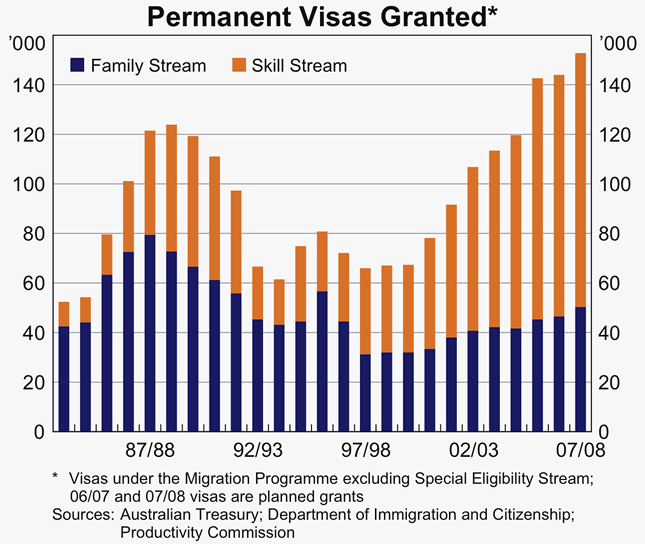
The Hawke government scrapped negative gearing in the mid-1980s but the policy was reinstated after investors fled the housing market, leading to a shortfall in rental accommodation.
Now, that was an interesting outcome. Wouldn't the houses have shifted to owner occupied, reducing the demand for rentals? Was something else causing the crush? Possibly immigration?
From http://www.rba.gov.au/publications/bulletin/2007/sep/2.html
ACOSS makes a plea for the cost of housing to come down not so the homeless can buy houses, but so that service providers have a chance of assisting those in need to find shelter. Ironic that if houses become too much of the economy they become more out of reach.

If elimination of the policy isn't possible, perhaps allowing negative gearing only for areas in need? It is a subsidy after all (someone else is paying the skipped taxes). It can be policy directed.

Monday, August 27, 2012

Canadian Housing Even Less Affordable

Canada housing affordability drops in 2nd quarter
The cost of owning a home edged up 0.2 percentage points to 43.4 percent for a detached bungalow and by 0.6 percentage points to 49.4 percent for a two-story home, while the measure for condos was unchanged at 28.8 percent, the RBC Housing Affordability index showed.
Home ownership was least affordable in Vancouver, where the benchmark for detached bungalows rose 2.2 percentage points to 91.0 percent, followed by Toronto, where it rose 0.9 percentage points to 54.5 percent. Ottawa was unchanged at 41.9 percent, Montreal was down 1.0 percentage points to 40.4 percent, Calgary was unchanged at 36.7 percent, and Edmonton fell 0.1 percentage points to 32.4 percent.
This measure is a straight up percent of pretax income needed to cover homeownership costs. The top end recommendation for the U.S. is 35% and that is in a lower tax rate environment.
Wright said he expected the Bank of Canada to start raising interest rates early next year, assuming problems in Europe and the United States are addressed.
I don't know about that optimism but raising rates in 2013 puts the most number of borrowers at risk due to the boom of expiring mortgages from the rush to refinance in 2007.
Note that the scale is wildly wrong, but I don't have a fix for it. It's just an indicator of where the balloon of trouble is from the feeding frenzy when 35 and 40 year mortgages became insured. That old post on subprime mortgages in Canada can be found here

I expect Bank of Canada will hold off until most of these mortgages are renewed and out of danger.